What is Agentic AI?
Agentic AI is a style of system built so an AI can help think, decide, and take steps toward a goal—not only print an answer and stop. In real products those steps run inside your software: APIs you expose, rules you enforce, and databases you trust.
If you have only used chat tools, you know the usual rhythm: you ask, the model answers, the interaction often ends there. Agentic setups change the rhythm: you pass a goal, the system may plan, call tools, observe results, and finish only when your definition of “done” is met (or when a safety limit stops the loop).
Normal AI vs agentic AI (the short contrast)
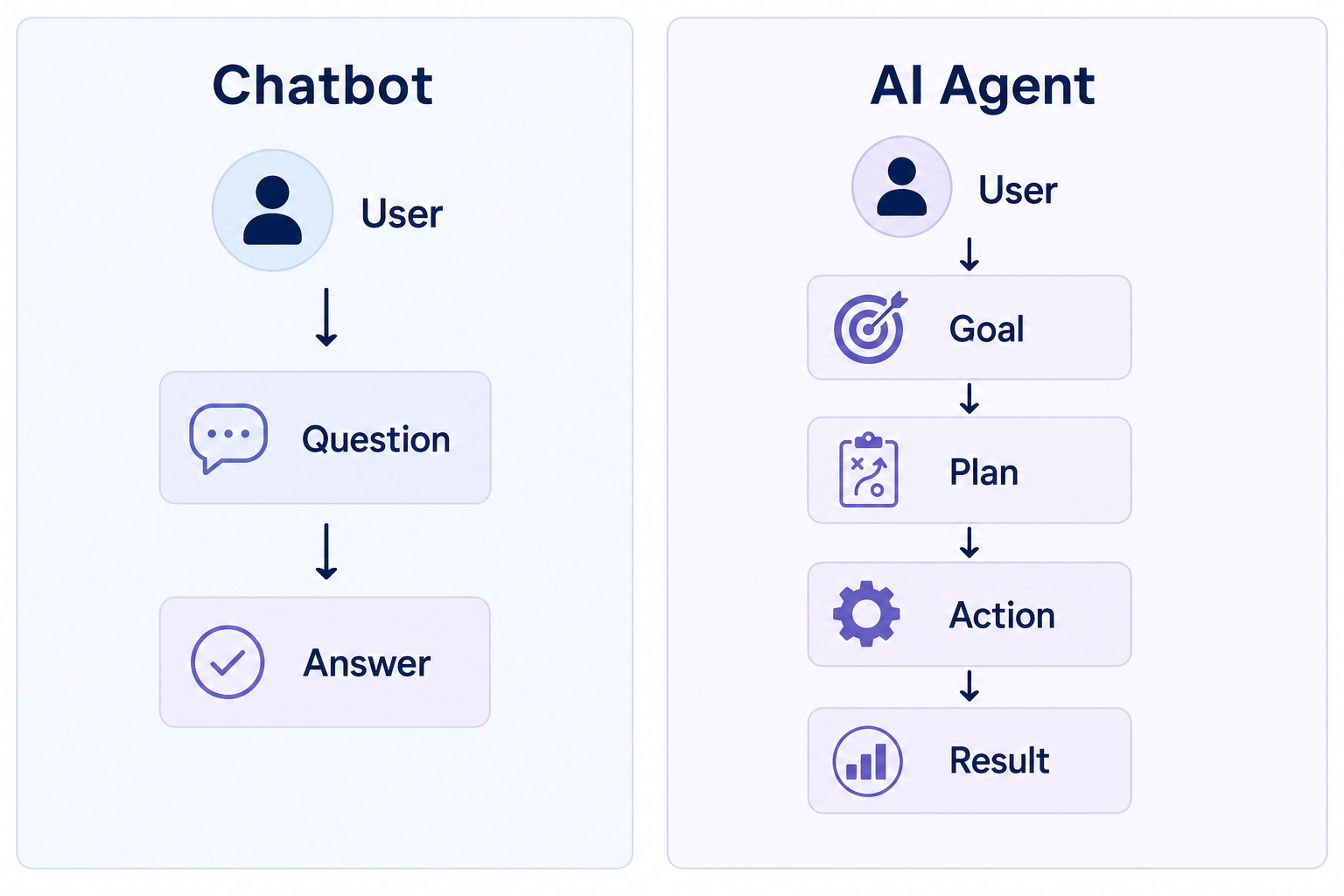
Normal AI (typical Q&A):
You ask → it answers.
Agentic AI:
You give a goal → it plans → takes steps → uses tools → returns a result.
That does not mean the AI should run unchecked in production. It means your application is allowed to loop: sense → decide → act → record, until success or timeout—same discipline you would expect from any automation.
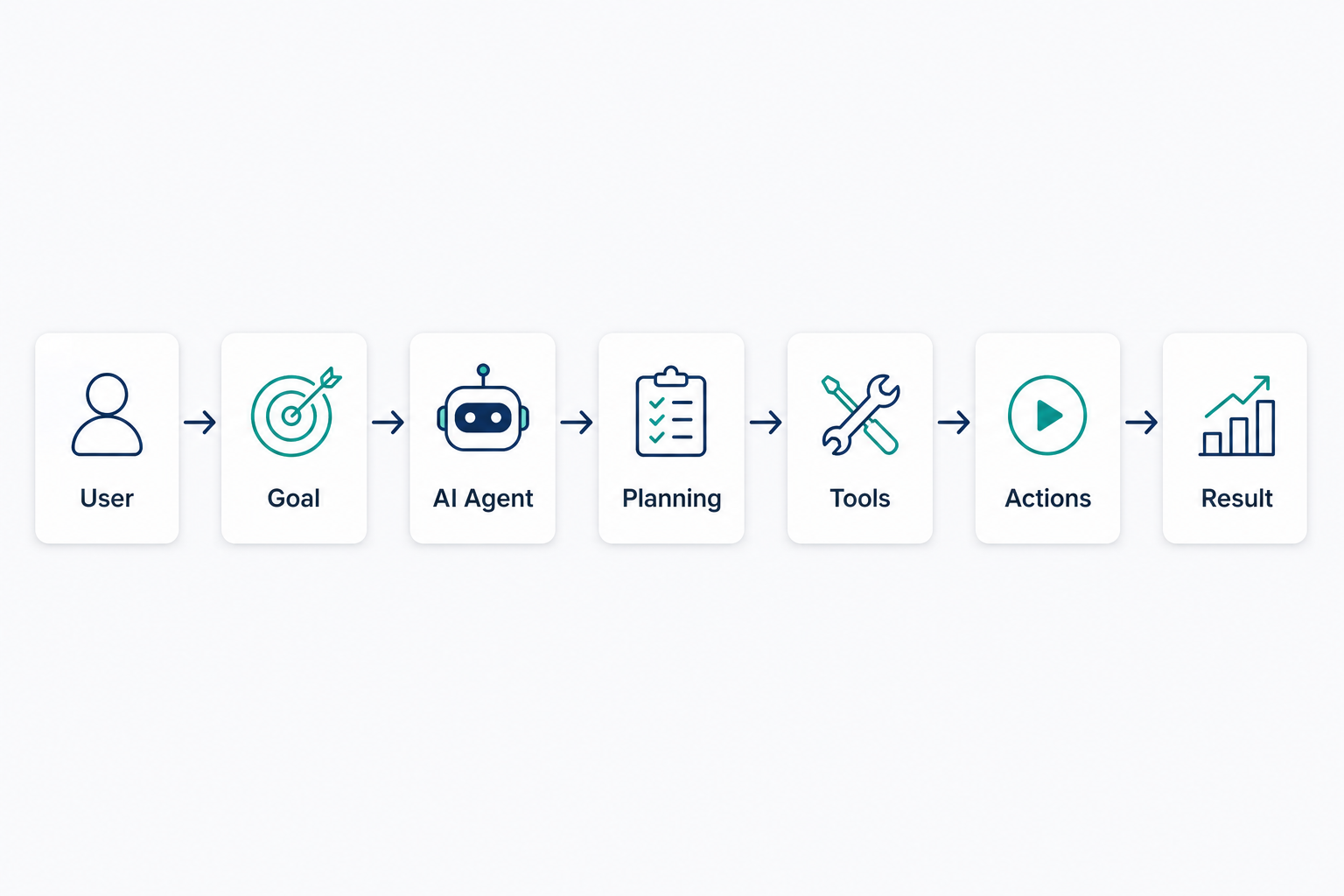
A simple mental picture: user and goal on the left, planning and tools in the middle, actions and outcome on the right.
Example: “Book me a flight from Delhi to Mumbai”
Imagine you say exactly that. A plain chat assistant might stop after listing flight ideas or explaining how booking works.
An agent-shaped flow could, in principle:
- Search available flights (through a search tool or API you integrated).
- Compare prices and constraints you configured (bags, time windows).
- Pick an option that fits your rules.
- Move toward booking—often with a human confirmation step for payment in real systems.
So it behaves more like a task-oriented assistant than a single-response bot. In production you still want confirmations, audit logs, and fraud checks; the point is the shape of the work: multi-step and outcome-driven.
AI agent vs normal chatbot
| Feature | AI agent | Typical chatbot |
|---|---|---|
| Behavior | Can drive actions (through tools you allow) | Mostly replies with text |
| Goal handling | Oriented toward finishing a task | Oriented toward answering a prompt |
| Memory | Can use conversation + stored state you design | Often limited to short context unless you build more |
| Tools | May call APIs, databases, ticket systems—via your backend | Usually no direct execution unless specially wired |
| Example | Flow that books or opens a ticket after checks | “Here are three flights you could consider” |
Simple labels many teams use:
- Chatbot ≈ answer machine.
- AI agent ≈ task executor (inside boundaries you code).
Same flight story:
- Chatbot-style reply: “Here are some flight options and links.”
- Agent-style outcome (when allowed by policy): “Your booking reference is XYZ” after real steps ran through approved tools.
Agentic AI vs generative AI
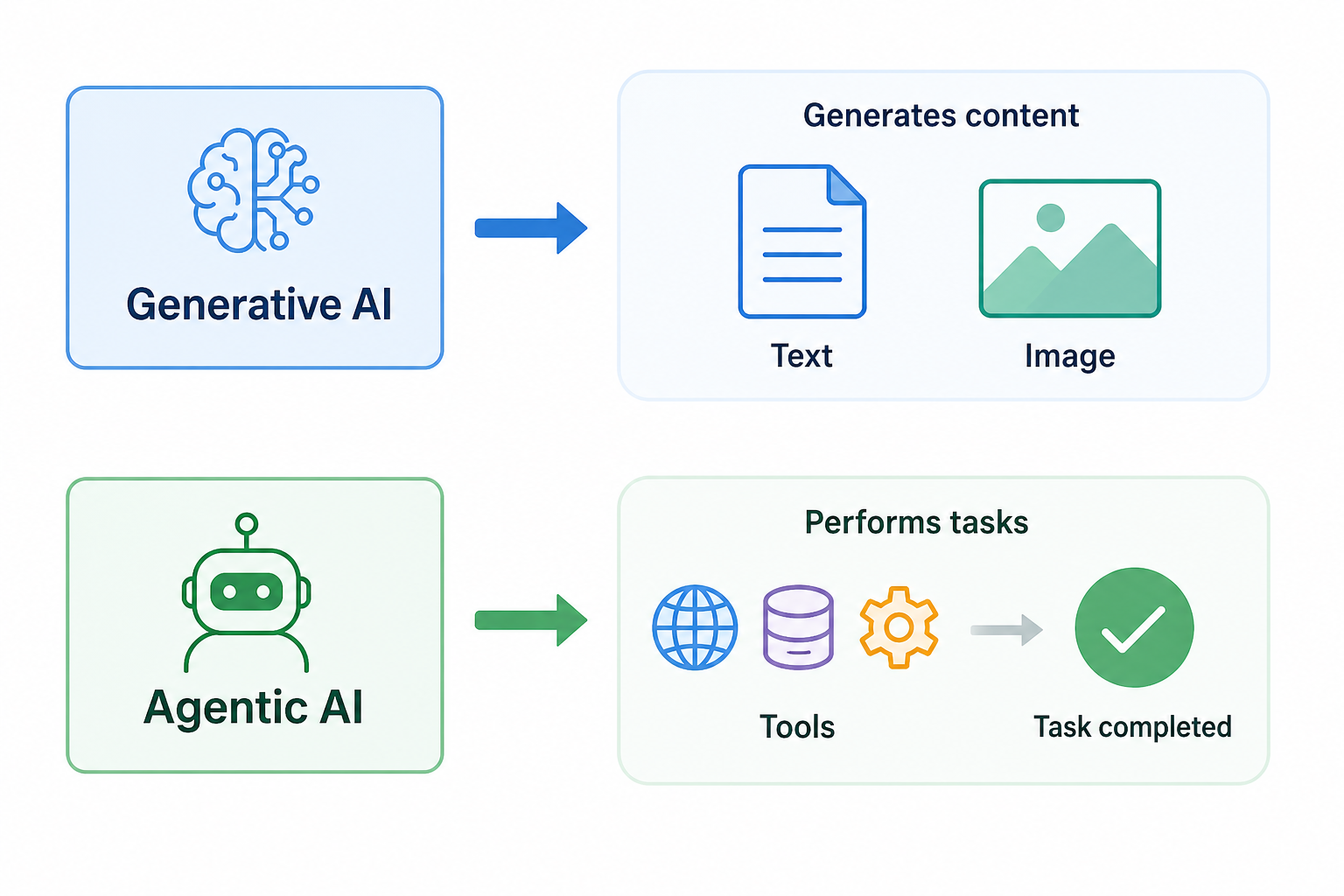
Generative AI (what people often mean when they say ChatGPT-style models) creates content: text, code snippets, images—output you can read or paste somewhere.
Agentic AI usually combines generative AI with decisions and actions: the model may draft a plan or tool call, but your system executes only what you permit.
| Topic | Generative AI | Agentic AI |
|---|---|---|
| Typical focus | Generates output | Completes multi-step work |
| Execution | Often no live execution in your stack | Can execute through tools you provide |
| Response style | Often a static answer per turn | Dynamic workflow across turns |
One-line shorthand:
- Generative AI ≈ creator (words, images, code blocks).
- Agentic AI ≈ doer (orchestrated through your services—not magic autonomy).
Generative AI can sit inside an agent; the extra piece is the loop, tool access, and stopping rules.
Why agentic AI is trending
Agentic AI gets attention because it moves the story from only talking to actually doing work—with guardrails—inside products teams already ship.
Common reasons:
- Automation demand — Businesses want fewer manual hops for repeatable workflows.
- Time — Fewer copy-paste steps when the system can chain allowed actions.
- Tool integration — Modern stacks already expose APIs, databases, and browsers through controlled interfaces.
- Multi-step planning — Models can suggest sequences; engineers decide what may run unsupervised.
- Visible outcomes — Not just “how to send email,” but (when policy allows) routing a draft into your send pipeline.
Tiny contrast:
- Only Q&A: “Here is how you send an email.”
- Agent-shaped (with your mail integration): prepare a draft, show preview, send after approval—still your mail server and your rules.
Real-life examples of agentic AI
These are patterns you see in industry—not guarantees that every product labeled “agent” implements them well:
- Booking and travel — Search, compare, and move toward reservations with confirmations.
- Customer support — Answer and trigger allowed actions (refund flows, ticket updates) behind permissions.
- Coding assistants — Suggest edits, run tests in a sandbox, open PRs—within repo policies.
- Personal assistants — Scheduling, reminders, drafts—often with explicit user confirmation.
- E-commerce — Recommendations plus checkout steps tied to inventory systems.
- Healthcare-style scheduling — Appointment lookup and reminders through integrated calendars (always subject to regulation and human oversight).
Each case still needs security, logging, and human gates where stakes are high.
Why your database and backend still matter
Models do not automatically know your customers, inventory, or yesterday’s incidents. In serious systems, PostgreSQL (or your store of record) stays authoritative. The agent reads and writes through the same Spring Boot layers you would use without AI: validation, transactions, roles.
This series refers to a com.codepathindia.agenticai-style layout so ideas stay tied to real Java services: thin controllers, testable orchestration, no silent root access for the model.
Three myths worth clearing up early
“Agentic” means fully autonomous.
Usually no. You cap turns, pick tools, and require humans where money or safety is involved.
Calling an API makes it safe.
API calls are still API calls—timeouts, retries, idempotency, and audits matter more when a model influenced the call.
You must buy a special brand to be agentic.
You need a clear loop, typed tools, and discipline—those are portable.
Try this on paper before you code
Pick a low-risk internal task (for example: summarize tickets from a table you own). Write down:
- What counts as done?
- Which tools may run without a human?
- What must never run without explicit approval?
If you can answer those, you are thinking in an agent-shaped way.
Final summary
Agentic AI pushes AI from answer-only interactions toward goal-seeking workflows that can plan, use tools, and produce outcomes—always inside limits you implement.
It does not replace solid engineering. It raises the importance of policy, observability, and data ownership—which is why we pair these ideas with Spring Boot + PostgreSQL + AI style backends.
- Chapter 2: What is an AI Agent? — concepts plus a plain Java skeleton (
com.codepathindia.agenticai) under Simple Java implementation of an AI Agent. - Part 3: Agent architecture — planner, executor, critic.
- Part 4: Important components — LLM, tools, memory, vectors, RAG.
- Part 5: Tools & function calling — tool use, APIs, search, code, SQL patterns.
- Agentic AI hub — overview and learning path